The Agent Economy: When Intelligence Becomes a Service You Can Hire
- published
- reading
- 9 min
- tags
- AI Agents · Robotics · Agentic Commerce
- author
- Atharv Kulkarni
AI agents and robots are converging into a new labor market where people buy outcomes, agents buy capabilities, and work is metered like cloud infrastructure.
Imagine starting a company the way you start a cloud project.
You describe the outcome, set a budget, define what the system may and may not do, and press start. Digital agents research the market, design the product, write the software, negotiate with suppliers, and coordinate delivery. When the work crosses into the physical world, they hire robots, factories, vehicles, or human specialists to complete it.
You do not assemble this workforce one employee or software subscription at a time. You rent capability on demand.
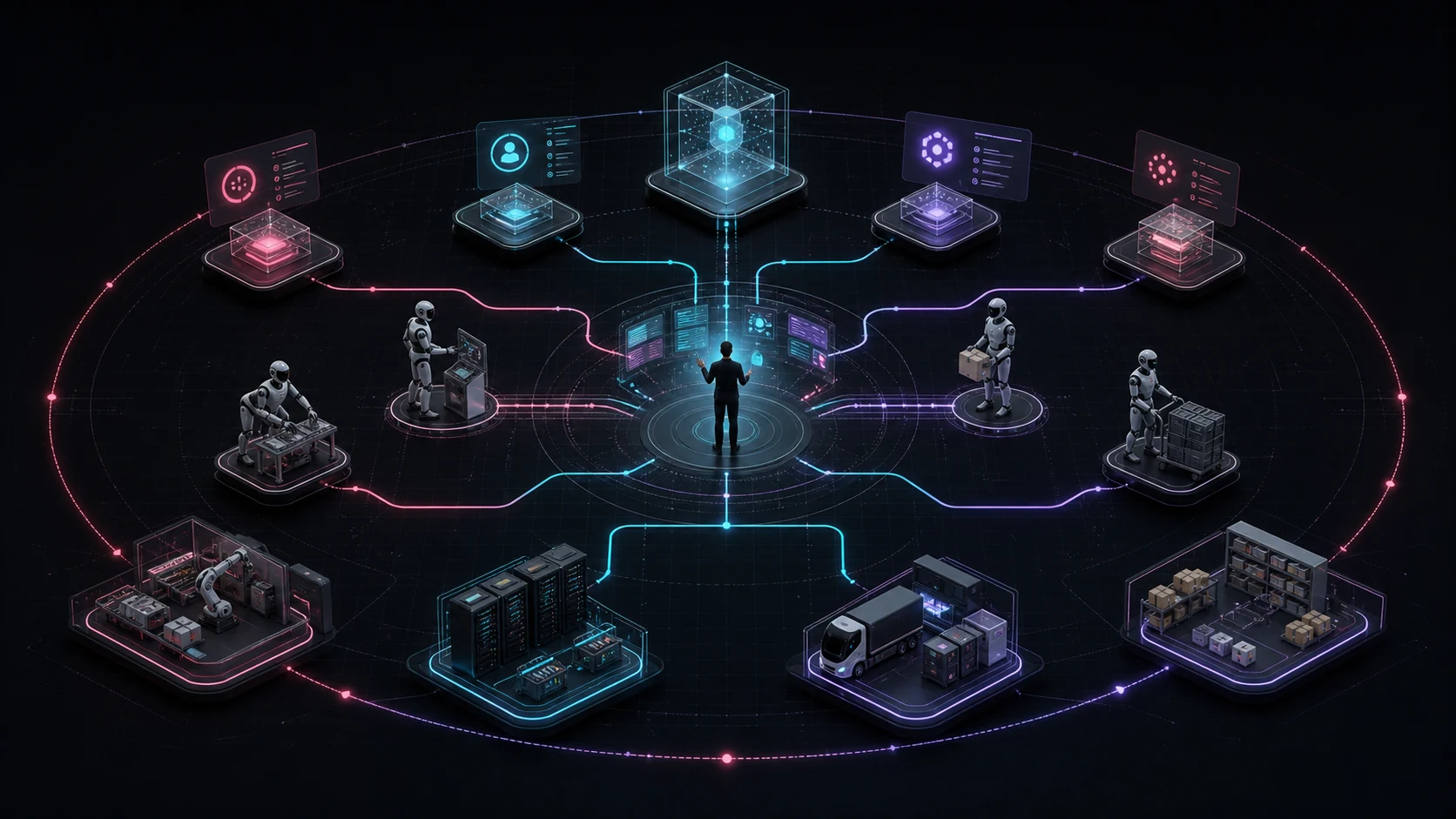
A business becomes an orchestration problem: combine the right intelligence, tools, and physical capacity around a goal.
This is the world I think we are moving toward: an agent economy in which intelligent digital and physical systems can discover one another, collaborate, transact, and charge for completed work.
It will not arrive as a single product or protocol. It is emerging from the convergence of better AI models, tool-using software agents, robotics, programmatic wallets, and machine-native payment standards.
Agents are becoming a new interface to labor
Most software today sells access to a tool. The customer still has to operate it.
Agents change that relationship. You give an agent a goal, context, tools, permissions, and a feedback loop. The agent decides what steps to take, performs the work, checks the result, and escalates when it reaches a boundary.
That creates two broad categories of machine labor.
Digital agents manipulate information. Coding agents such as Codex and Claude Code can already inspect repositories, change software, run tests, and iterate on failures. Other agents can research, analyze data, operate business software, prepare campaigns, reconcile invoices, or coordinate complex workflows.
Physical agents manipulate the real world. Humanoid projects such as Tesla Optimus, Figure, and Agility Robotics' Digit are the most visible examples, but the category is much larger than humanoids. A warehouse arm, autonomous vehicle, inspection drone, or purpose-built agricultural robot is also a physical agent when it can perceive, decide, act, and adapt.
Humanoid robots matter because our environments were designed for human bodies. Specialized robots matter because many jobs do not require a human shape at all. The future is likely to contain both.
From software as a service to agents as a service
The next generation of companies will not merely sell models or software seats. They will sell reliable units of work.
An agent-as-a-service company might promise to:
- resolve a support request;
- migrate a software module;
- qualify a sales lead;
- inspect a warehouse aisle;
- pick and pack an order;
- produce a manufactured component;
- or operate an entire back-office workflow.
The customer should not need to know how many model calls, tools, sub-agents, or robot-minutes were required. They should be able to specify the outcome, the service level, the constraints, and the price they are willing to pay.
This is the same abstraction that made cloud computing powerful. Customers stopped buying physical servers for every workload and started buying metered compute. In an agent economy, they may stop assembling every capability internally and start buying metered work.
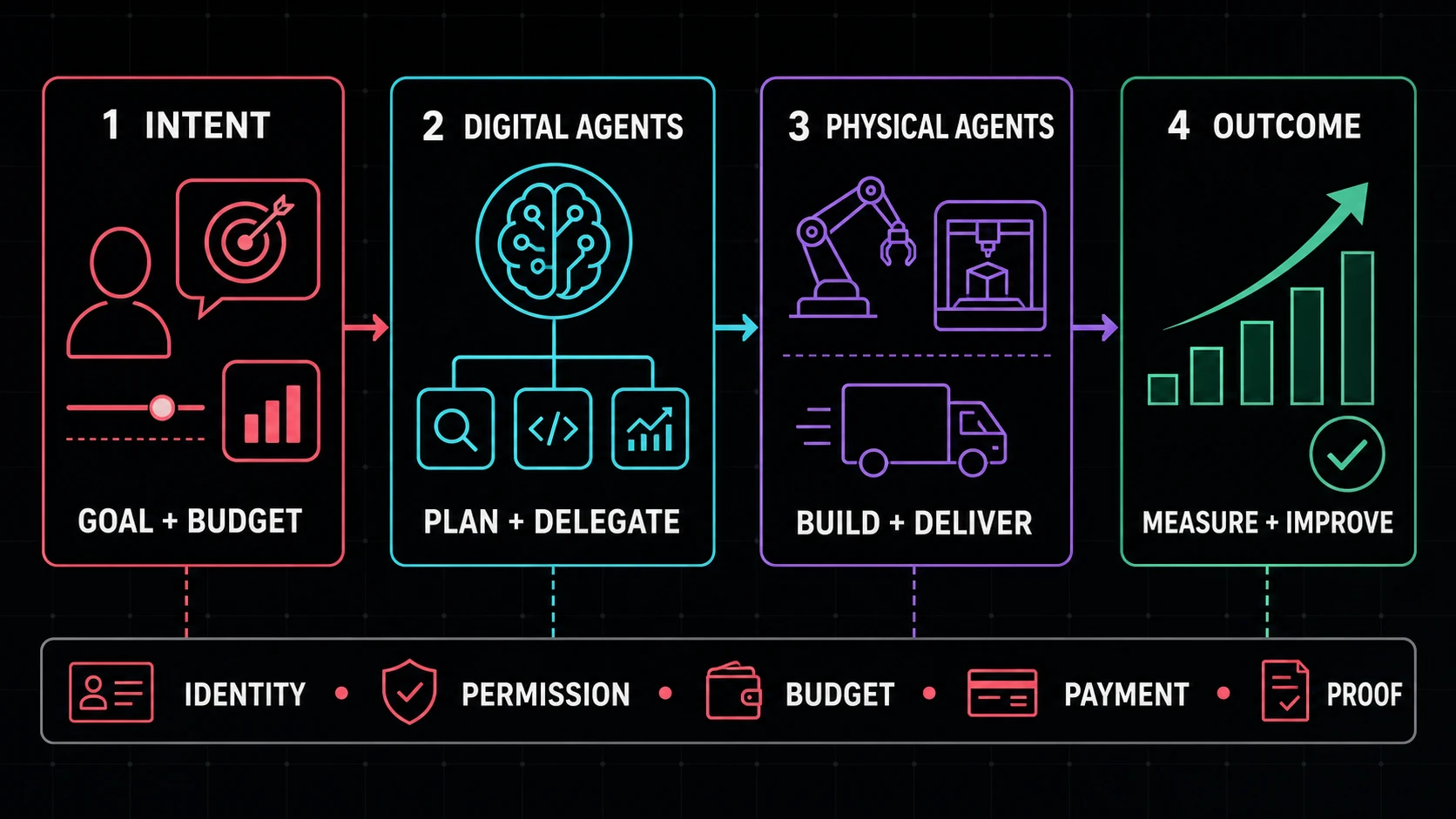
The execution layer performs the work. The trust layer determines who may act, how much they may spend, and how the result is verified.
A concrete example: a one-person product company
Consider a founder who wants to launch a new physical product.
Today, that person may need market researchers, industrial designers, software engineers, sourcing specialists, a contract manufacturer, a logistics provider, a marketing team, and an accountant. The coordination cost alone can prevent the business from existing.
In an agent economy, the workflow could look like this:
- The founder defines the product idea, target customer, quality bar, risk tolerance, and total budget.
- A lead digital agent breaks the goal into research, design, validation, production, distribution, and sales workstreams.
- Specialist agents test demand, prepare designs, build the storefront, compare suppliers, and model unit economics.
- The lead agent purchases additional capabilities when needed: a simulation, a legal review, a prototype run, or access to a manufacturing cell.
- Physical agents fabricate, inspect, pack, and move the product through the real world.
- Every action produces evidence: quotes, approvals, test results, payment receipts, and delivery confirmation.
- The founder reviews exceptions and strategic choices while the system handles execution.
This does not make the founder irrelevant. It changes the founder's job. Human leverage moves toward intent, taste, judgment, relationships, capital allocation, and accountability.
Why agents need their own economic infrastructure
An agent that can act but cannot acquire resources remains dependent on a human for every transaction. An agent that can spend without controls is unsafe.
A functioning agent economy therefore needs at least five primitives:
- Discovery: Which agent or service can perform this task?
- Identity and reputation: Who operates it, and what evidence supports its claims?
- Authorization: What data, tools, merchants, and actions may it access?
- Budgets and payments: How much may it spend, under what conditions, and through which rail?
- Proof: What was delivered, who approved it, and can the result be audited?
Several emerging projects are starting to fill in pieces of this stack.
Coinbase's x402 turns the long-unused HTTP 402 Payment Required status into a programmatic payment flow. A client requests a paid resource, the server replies with payment requirements, the client signs a payment payload, and the request is retried. The pattern is attractive for agents because payment can happen inside the same machine-to-machine interaction used to request an API or service.
Wallet infrastructure supplies another piece. Coinbase AgentKit and its newer Agentic Wallet are examples of tooling designed to let agents hold or move funds and pay for services with explicit security controls.
Commerce and authorization standards are developing in parallel. Google's open-source Universal Commerce Protocol defines common commerce interactions, while the Agent Payments Protocol adds mandates that can express user intent, spending limits, approved merchants, and proof of authorization.
These projects should not be mistaken for one finished, universal agent stack. They solve different parts of the problem, are still evolving, and will need to interoperate with conventional banking, cards, stablecoins, invoices, procurement systems, identity providers, and regulation.
The important signal is the direction: machines are gaining ways to request, authorize, pay for, and prove economic activity through software.
How agent work may be priced
Early AI products are commonly priced by tokens or subscriptions because those are easy inputs to measure. Agent companies will need models that better reflect the work customers are buying.
I expect several pricing patterns to coexist:
- Per action: one API call, inspection, delivery, or database operation.
- Per task: one resolved ticket, generated campaign, tested feature, or packed order.
- Per capacity unit: an hour of an agent, robot, vehicle, or manufacturing cell.
- Per outcome: a percentage of recovered revenue, saved cost, or completed transaction.
- Reserved service: guaranteed capacity and response time for a recurring fee.
Underneath, the provider may still meter tokens, compute, energy, tool calls, and robot time. But the customer-facing unit will gradually move closer to an outcome.
That transition matters. Cloud providers made infrastructure elastic. Agent providers can make execution elastic.
The companies this economy creates
The most obvious businesses will sell agents, but the larger opportunity is the market around them.
Capability providers will offer specialized work: code migration, scientific analysis, freight booking, quality inspection, or robotic picking.
Orchestrators will translate a goal into a plan, select providers, manage a budget, combine outputs, and recover from failure.
Trust infrastructure will handle identity, permissions, credential management, policy enforcement, audit trails, reputation, and dispute resolution.
Marketplaces will help agents discover capabilities by price, latency, geography, quality, and compliance requirements.
Evaluation and insurance providers will verify that work meets a specification and absorb some of the liability when it does not.
The winning companies may look less like chatbot vendors and more like a mixture of a staffing firm, cloud platform, marketplace, and operating system.
What still has to be solved
The vision is compelling precisely because the unsolved problems are substantial.
Reliability: A demo that succeeds eight times out of ten is impressive; a business process that fails twice out of ten is unusable. Agents need evaluation, observability, retries, fallbacks, and clear escalation paths.
Authority: Every agent needs a narrow, inspectable scope. A budget is not enough; systems must also restrict counterparties, data access, action types, geography, time, and risk.
Security: Agents combine untrusted inputs with powerful tools. Prompt injection, credential theft, malicious services, and compromised robots become economic and physical threats.
Liability: When a chain of agents causes harm, who is responsible: the owner, orchestrator, model provider, tool vendor, or robot operator? Markets will need contracts, regulation, evidence, and insurance.
Quality and reputation: Agents need machine-readable ways to compare providers without trusting self-reported claims. Verifiable test results and transaction history may become as important as price.
Human impact: More leverage can create abundance, but it can also concentrate ownership and disrupt work faster than institutions adapt. An agent economy needs a serious conversation about access, transition, and who captures the gains.
What arrives first
The first durable agent markets will form where work is already digital, outcomes are easy to verify, and mistakes are reversible. Software engineering, research, customer operations, analytics, and back-office processes fit this pattern.
Physical agents will expand first in controlled environments such as warehouses, factories, labs, farms, and logistics networks. These spaces offer repeatable tasks, measurable economics, and stronger safety boundaries than an open-ended home or city.
Over time, the boundary will blur. A digital agent will not care whether a capability is delivered by an API, a person, a robot, or another company. It will care about the specification, cost, availability, permissions, and evidence of completion.
That is the deeper change.
The internet made information globally addressable. Cloud computing made compute globally rentable. The agent economy could make capability itself programmable.
When that happens, starting a company will require less ownership of labor and infrastructure—but much more clarity about goals, constraints, and responsibility. The scarce skill will not simply be doing every task yourself. It will be knowing what should be done, what must never be delegated, and how to verify the difference.